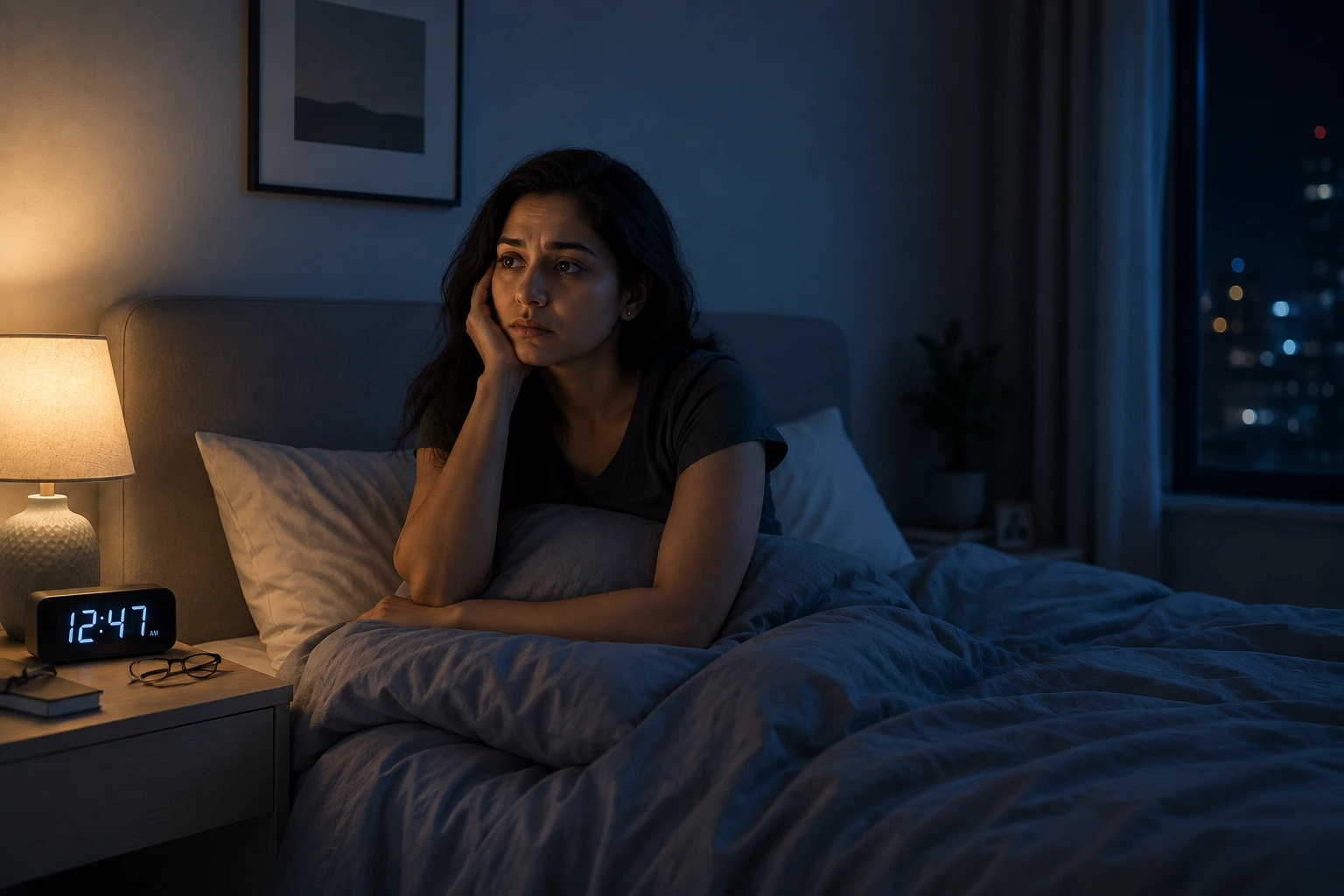
You are tired at 10 PM. Your body feels exhausted. Your eyes feel heavy. You have been waiting all day to finally get into bed.
Then you lie down. 11:00 PM. Still awake. 11:30 PM. You change sides. 12:05 AM. You look at the clock and wonder: “I was so tired. Why am I suddenly unable to sleep?” Then comes another thought: “If I don’t sleep now, tomorrow is going to be terrible.” And before you know it, falling asleep has become another task you are trying to accomplish.
If this happens regularly, you are far from alone. A large 2025 global analysis pooling 18 studies and more than 262,000 adults estimated clinically relevant insomnia in approximately 16.2% of adults worldwide — around 852 million people. India has a significant sleep burden too: a 2025 review of 100 Indian studies put general-population insomnia prevalence at around 15%.
These figures don’t mean everyone who takes time to fall asleep has insomnia. They tell us something simpler: millions of people are finding it difficult to make the transition from wakefulness to sleep. Why?
First, Understand This: Tired Is Not Always Sleepy
This may be one of the most important distinctions in understanding sleep. You can be tired because you worked for twelve hours, travelled through traffic, exercised, managed children, attended meetings, solved problems or worried throughout the day. Your body can feel completely exhausted. But that doesn’t automatically mean all the biological systems involved in sleep are ready to switch states.
One of sleep science’s major models describes sleep timing as an interaction between homeostatic sleep pressure, which builds with time awake, and the circadian system, which helps regulate when the body promotes wakefulness and sleep. There’s another important influence too: how alert is your mind and nervous system? Sleep researchers describe this as hyperarousal — increased activation across cognitive-emotional, cortical and physiological domains. In other words, someone can be physically tired while parts of the brain involved in thinking, vigilance and arousal remain highly active. That creates a very common modern experience:
Tired Body + Alert Mind = Delayed Sleep
Your Body Is Tired. But What Floor Is Your Mind On?
Imagine your mind as a building. During the day, you are thinking, solving, planning, responding, analysing, driving, scrolling, worrying, competing and making decisions. The brain during active wakefulness contains faster-frequency activity, and studies of people with insomnia have repeatedly found greater beta or other higher-frequency brain activity around sleep onset and during parts of sleep — supporting the broader idea of cortical hyperarousal.
For simplicity, imagine this highly alert mental state as the Top Floor — the Alert Mind: thinking, solving, planning, predicting, worrying, watching, reacting. This is what we can call the High Beta Alert Mind. That does not mean every neuron in your brain is literally operating in one “high-beta” frequency — brain activity is far more complex than that. It’s a simple way of describing the experience: “my body wants to stop, but my mind is still doing.”
But Sleep Is Downstairs
The transition from wakefulness into sleep involves changing patterns of brain activity. During quiet wakefulness with the eyes closed, alpha activity can become prominent. As sleep begins, N1 sleep contains more slower mixed-frequency/theta-range activity, while deep N3 sleep is characterised by prominent slow-wave or delta activity.
So, as a conceptual analogy: the alert wakefulness of the Top Floor (faster, beta-range activity) gradually gives way to relaxed wakefulness (more alpha activity), then early sleep (more theta-range activity), before finally reaching the Ground Floor of deep, slow-wave sleep (delta activity).
The brain does not literally travel through four separate floors in a neat sequence — EEG frequencies overlap, sleep has multiple stages, and REM sleep has very different brain activity. But the metaphor teaches us something useful: how can a mind that has spent the whole day on the Top Floor suddenly reach the Ground Floor just because we put our head on a pillow?
We Expect Sleep to Work Like an Elevator
Think about a typical modern evening: 10:15 PM, finish work. 10:25 PM, answer WhatsApp. 10:40 PM, check Instagram. 10:55 PM, breaking news. 11:05 PM, one episode. 11:25 PM, check tomorrow’s calendar. 11:40 PM, one final message. Then: 11:46 PM — phone down, eyes closed. And we tell the brain “sleep now.”
We expect an instant elevator, Top Floor to Ground Floor. But the mind may still be planning. The nervous system may still be alert. The body clock may not yet be optimally aligned. Sleep pressure, circadian timing and arousal don’t disappear or transform simply because we’ve entered the bedroom — sleep research consistently points to persistent cognitive-emotional and cortical arousal as one of the biggest reasons sleep gets delayed.

An educational analogy — brain-wave activity overlaps and does not move through perfectly separate “floors.”
So perhaps the problem isn’t “why is sleep not coming?” A better question may be: have I actually given my brain enough opportunity to come down the floors?
Three Foundations Influence That Journey
This is where the Sleep Tripod™ becomes useful. Instead of looking only at bedtime, look at three interconnected foundations.
1. Circadian Rhythm — is your Body Clock saying it is time to sleep? Your internal timing system influences when wakefulness and sleep are biologically favoured; sleep timing reflects the interaction between the circadian process and accumulated sleep pressure. Deciding “from tonight I will sleep at 9:30 PM” doesn’t necessarily make sleep arrive at 9:30 PM. If your body has become accustomed to sleeping closer to midnight, your intention may have changed faster than your biology. The wall clock says bedtime. Your body clock may still be saying not yet.
2. Calm Nervous System — has your system actually come out of Alert Mode? Closing your laptop isn’t necessarily the same thing as closing the workday inside your mind. Perhaps the meeting is over, but you’re replaying it. The children are asleep, but you’re thinking about tomorrow. The phone is away, but your brain is calculating. Hyperarousal is considered an important mechanism in insomnia, particularly cognitive-emotional arousal and higher-frequency cortical activity. The body may be in bed, but part of the system is still at work.
3. Mind–Body Chemistry — what internal state have you practised throughout the day? Cortisol, adrenaline and noradrenaline are not “bad hormones” — they are essential systems involved in alertness and responding to demands. The issue isn’t that we should eliminate alertness. The issue is flexibility: can we activate when life requires it, and recover once the challenge has passed? A day dominated by urgency, frustration, threat, comparison and constant stimulation feels very different internally from a day that also contains movement, laughter, connection, gratitude, purpose, safety and emotional recovery. Sleep isn’t created only during the final 20 minutes before bed — the state we repeatedly practise during the day influences the state we carry into the night.
Sometimes We Go to Bed Because the Clock Says So
There’s an important difference between “it is 10:30 PM, so I should sleep” and “I am becoming genuinely sleepy.” If you’re exhausted but still mentally alert, simply spending more time in bed doesn’t guarantee sleep will arrive. You lie there waiting, notice you’re awake, and gradually the attention shifts from sleep to not sleeping.
That shift has a familiar shape: 11:20 PM — “I’m not asleep yet.” 11:42 PM — “why am I still awake?” 12:05 AM — “now I only have six hours.” 12:30 AM — “tomorrow will be ruined.” Now sleep has become another performance target, and the brain has been given another problem: “I must make sleep happen.” The more attention we give to “why am I awake?”, the more wakefulness itself can become the centre of attention. We can decide to walk, eat, or send an email — but we cannot simply command “become unconscious now.” Sleep emerges when the conditions become favourable.
What’s Quietly Working Against You
Two ordinary habits are worth checking honestly.
The first is what bedtime actually contains. Modern humans often go to bed without actually ending the day — phone, WhatsApp, Instagram, YouTube, email, news, one more episode, one final work message. Researchers have even distinguished bedtime from “shuteye time” — when someone actually stops other activities and attempts to sleep — and a 2024 meta-analysis of 55 papers and over 41,000 participants across more than 20 countries found electronic-media use associated with poorer sleep outcomes. The issue isn’t simply “blue light is bad” — we’ve turned the bedroom into another place for work, entertainment, comparison and stimulation, then expect the brain to leave that world immediately once the screen goes dark.
The second is caffeine. Sensitivity differs considerably between people, and both dose and timing matter — one controlled study found 400 mg of caffeine disrupted sleep even when consumed six hours before bedtime, while smaller doses behaved differently. The useful question isn’t “should I quit coffee?” but could my dose, timing or personal sensitivity be contributing to delayed sleep? Sometimes an 11 PM sleep problem begins much earlier in the day.
Sometimes the Day Ends but the Mind Doesn’t
Wake up, phone, rush, traffic, target, meeting, deadline, notification, financial concern, argument, news, more work, tomorrow’s planning. Then: lights off, “okay brain, stop.” But perhaps that brain has spent the previous sixteen hours rehearsing “go.” Modern insomnia models repeatedly highlight hyperarousal, worry and stress-related reactivity as contributors to difficulty sleeping. This is why a person can say “I am completely exhausted, but my brain simply won’t switch off.” Their tiredness is real. Their alertness can be real too. Both can exist simultaneously.
NEUROREST™: Don’t Wait Until Bedtime to Come Down the Floors
The NEUROREST™ framework behind thousands of transformation journeys at Sleep Gurukul has taught us one important lesson: better sleep is rarely built only at bedtime. If the brain has spent the entire day practising alertness, the answer cannot always be to demand instant calmness at 11 PM — the transition needs to begin earlier. NEUROREST™ looks at the different signals that may be keeping the mind and body awake and gradually works on changing those signals:
- Restore the Body Clock — strengthen the distinction between day and night through regularity, daylight, appropriate activity and consistent rhythms, so biology receives clearer information about when the day is ending.
- Energise Body Movement — movement and exercise belong to the daytime side of the equation; an active day and a recovering night support each other.
- Unwind Overthinking — not to force the brain to become empty, but to gradually reduce the mental loops that keep returning to what happened, what might happen, what went wrong and what must be solved tomorrow.
- Reset the Nervous System — breathing, relaxation and mind-body practices become ways of repeatedly practising the transition from activation to recovery, rather than expecting calmness to magically appear after switching off the light.
- Nurture the Sleep Environment — light, sound, temperature, digital stimulation and what we repeatedly do in bed all become signals that the day is ending.
- Elevate Emotional Wellbeing — a healthy day isn’t defined only by how much stress we managed to avoid; it can also contain connection, gratitude, laughter, purpose, enjoyment, movement, achievement and emotional safety.
The aim is not to live without alertness. It is to regain the ability to change states.
The Goal Is Not to Jump Floors
If your brain is on the Top Floor at 11:30 PM, don’t become frustrated because it hasn’t reached the Ground Floor at 11:35 PM. Instead, ask how you can gradually come down — from doing to slowing, from solving to releasing, from checking to disconnecting, from alertness to calmness, from wakefulness to sleep. Your evening becomes a transition, rather than a sudden command.
Don’t Only Fix the Night
This is why people sometimes become frustrated after trying one sleep hack after another — a better mattress, a supplement, a meditation, a breathing exercise, a sleep spray, no phone for twenty minutes — yet nothing fundamentally changes. Tonight’s sleep may have been influenced by what happened from the moment you woke up. Ask yourself: when did I wake? Did I get daylight? Did I move? Did I nap? How much caffeine did I consume? How stimulated was my day? When did work really finish? What did I consume mentally during the evening? Was I actually sleepy when I went to bed, or merely exhausted? And perhaps the most important question: what floor was my mind on when I switched off the light?
When Difficulty Falling Asleep Deserves Attention
An occasional difficult night is part of being human. But if you’re regularly struggling to fall asleep, it continues for weeks or months, or poor sleep is affecting your mood, energy, concentration, work or everyday life, it deserves attention and appropriate help. Persistent difficulty falling or staying asleep three or more nights per week for at least three months, together with daytime impact, is part of the clinical framework used for chronic insomnia.
The objective shouldn’t be to immediately label yourself — it should be to understand your pattern. Is your body clock delayed? Is your nervous system still alert? Is your mind continuing to solve and anticipate? Are caffeine or evening stimulation contributing? Is your daily rhythm confusing the distinction between day and night? Or could another physical, psychological or sleep-related issue require appropriate professional evaluation? The important question isn’t “which sleep hack should I try next?” It’s: what is actually keeping me awake?
The Sleep Tripod™ Perspective
So perhaps instead of asking “why can’t I force myself to sleep at 10:30 PM?”, ask three different questions: is my body clock ready for sleep? Has my nervous system moved out of alert mode? Is my mind–body chemistry moving towards recovery? Together, these form the Sleep Tripod™, and when we look through that lens, delayed sleep starts making more sense.
Maybe your body hasn’t forgotten how to sleep. Perhaps it’s simply receiving too many signals saying stay awake, and too few saying you can let go now. Better sleep therefore may not begin by trying harder to sleep. It may begin by helping the mind and body gradually come down the floors: alert → calm → sleep.
Key Takeaways
- Tiredness and sleepiness are not necessarily the same thing.
- Sleep timing is influenced by sleep pressure and the circadian system, while alertness can influence how easily the transition occurs.
- Studies on insomnia show elevated beta/high-frequency brain activity, supporting the concept of cortical hyperarousal.
- The Top Floor → Ground Floor model is an analogy: the brain does not literally travel through Beta, Alpha, Theta and Delta as four perfectly separated steps.
- Going to bed earlier does not necessarily mean you will fall asleep earlier.
- Screens can influence sleep through stimulation and displacement of sleep, not simply blue light.
- Caffeine effects depend on dose, timing and individual sensitivity.
- The Sleep Tripod™ asks whether Body Clock, Nervous System and Mind–Body Chemistry are all moving in the direction of sleep.
- NEUROREST™ approaches sleep as something we prepare for through the whole day, not something we suddenly manufacture at bedtime.
- The goal is not to force sleep — it is to create better conditions for the brain and body to move from alertness to calmness to sleep.
Frequently Asked Questions
Why can’t I fall asleep even though I am exhausted? Because physical exhaustion doesn’t automatically mean that sleep pressure, circadian timing and mental arousal are all aligned. Hyperarousal can coexist with tiredness, leaving someone feeling physically drained but mentally awake.
Why does my mind suddenly become active when I lie down? Once external activity stops, internal thoughts can become more noticeable. Worry, planning, rumination and sleep-related monitoring are recognised elements of cognitive-emotional hyperarousal in insomnia.
Is my brain really in “High Beta” when I cannot sleep? Not necessarily in the literal sense. High Beta Alert Mind is a simplified explanatory concept. Sleep researchers have, however, found increased beta or other higher-frequency activity around sleep onset and during sleep in some groups with insomnia compared with good sleepers.
Does the brain really move Beta → Alpha → Theta → Delta? Not as a simple four-step staircase. The analogy helps explain the overall movement from alert wakefulness towards slower activity associated with sleep. Brain frequencies overlap, and REM sleep again has very different, mixed-frequency activity.
Why can I sleep on the sofa but become awake when I go to bed? Sometimes sleepiness emerges naturally when there’s no pressure to sleep. Once you enter bed, the thought “I have to sleep now” can introduce monitoring, effort, worry and anticipation — exactly the cognitive-emotional activation associated with insomnia hyperarousal.
Should I simply go to bed earlier if I want to sleep earlier? Not always. Sleep timing depends partly on the interaction between circadian timing and accumulated sleep pressure. Moving bedtime earlier does not automatically move those biological processes by the same amount.
What Is Keeping You Awake?
Discover whether your Body Clock, Nervous System or Mind–Body Chemistry may be affecting your sleep. Take the 3-Minute Sleep Assessment →
Scientific References
This article draws on published sleep research, including work on hyperarousal in insomnia, beta EEG activity and sleep onset, the two-process model of sleep regulation, and recent survey data on insomnia prevalence in India.
This article simplifies established sleep science for a general audience using the Sleep Tripod™ and NEUROREST™ frameworks. The “Top Floor to Ground Floor” brain-wave analogy is an educational metaphor rather than a literal description of how the brain moves through sleep. The article is educational and is not intended to diagnose or replace individual healthcare advice.
